

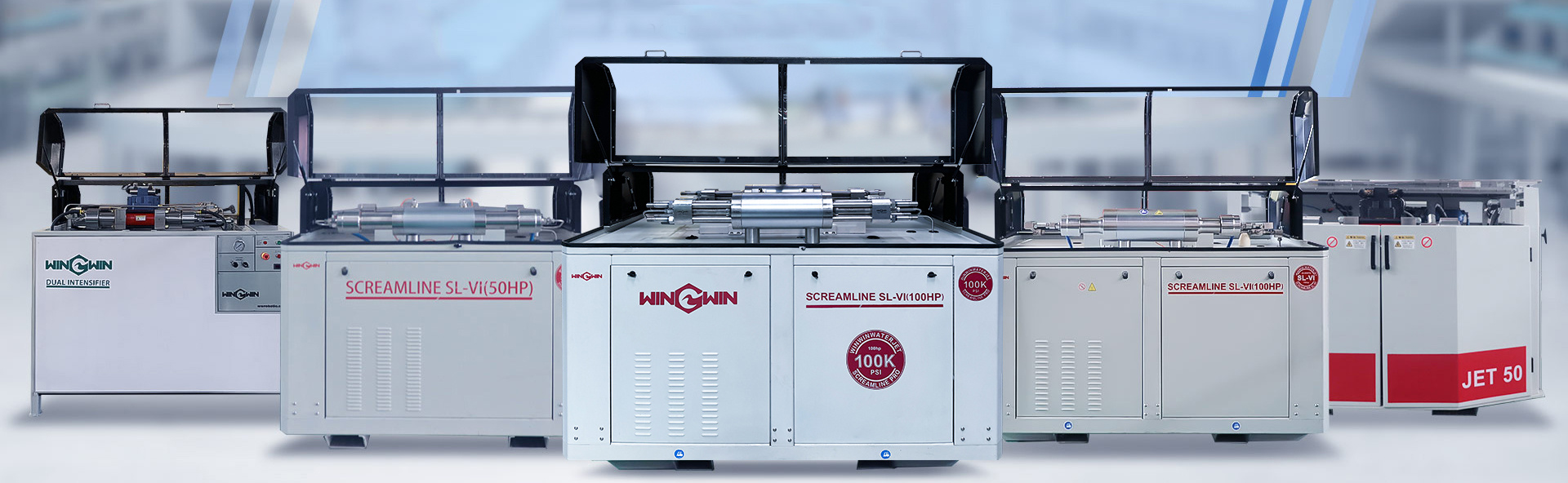
Win Win at the 2014 International Equipment Manufacturing Exposition
2026-11-03
author:
Water jet cutting robots are sophisticated tools that use high-pressure streams of water, often mixed with abrasives, to cut through metal with great precision. Here’s a detailed look at how they work and the process involved in cutting metal:
Components of a Water Jet Cutting System
Robot Arm: This is the core of the water jet cutting system. The robot arm is typically articulated with multiple degrees of freedom, allowing it to maneuver the cutting head accurately along complex paths.
Cutting Head: The cutting head is attached to the end of the robot arm and includes a nozzle through which the high-pressure water jet is emitted. In some systems, this nozzle is designed to mix water with abrasive particles (like garnet) to enhance cutting capability.
High-Pressure Pump: This pump generates the intense pressure required to force water through the nozzle. Pressure levels typically range from 20,000 to 60,000 psi (pounds per square inch), but some systems can go higher.
Abrasive Injector (if used): In abrasive water jet cutting, an injector mixes abrasive particles with the water stream. This mixture helps to cut through harder materials by increasing the cutting power of the jet.
Control System: This includes a computer or programmable logic controller (PLC) that coordinates the movements of the robot arm and controls the cutting parameters such as pressure, speed, and direction.
Worktable: The metal workpiece is placed on a worktable, which may have a grid or clamping system to secure it during cutting.
Cutting Process
Setup and Programming: The metal workpiece is positioned on the worktable, and the cutting path is programmed into the control system. The robot arm is calibrated to ensure accurate cutting according to the design specifications.
High-Pressure Water Jet Generation: The high-pressure pump forces water through the nozzle at extremely high speeds. If abrasive cutting is used, the abrasive particles are mixed with the water stream at this stage.
Cutting: The robot arm moves the cutting head along the programmed path. The high-pressure water jet (and abrasive, if used) erodes the metal material to follow the desired contour. The cutting head can make precise, intricate cuts, and the robot arm’s movements can be highly controlled to achieve complex geometries.
Coolant and Waste Removal: During cutting, the water jet also acts as a coolant, reducing the risk of heat distortion. The system often includes mechanisms to collect and remove the waste material and used water to maintain a clean cutting area.
Post-Cutting: After the cutting process is complete, the metal parts are inspected and any additional finishing work is performed if needed.
Applications
Aerospace: Cutting complex aerospace components with high precision.
Automotive: Manufacturing parts with complex geometries and tight tolerances.
Construction: Cutting metal components for structural and architectural applications.
Art and Design: Creating intricate metal designs for art or decorative elements.
In summary, water jet cutting robots provide an efficient and precise method for cutting metal, leveraging high-pressure water streams to achieve intricate cuts without affecting the material’s properties.

Scan the QR code
Contact us

Email:service@winwinwaterjet.com
Address:63-32 Qixing Street, Shenbei New District, Shenyang City, Liaoning Province


